

How to Brew Fresh Coffee Beans: A Step-by-Step Guide
Table of Contents
- Why Fresh Coffee Beans Matter (and Why We're Committed to Getting Them to You)
- What You'll Need Before You Start Brewing
- Step 1: Select and Inspect Your Whole Coffee Beans
- Step 2: Grind Your Beans to the Right Size
- Step 3: Measure Your Coffee and Water Using the Right Coffee-to-Water Ratio for Brewing
- Step 4: Heat Water to the Best Water Temperature for Brewing Coffee
- Step 5: Brew and Learn How Long to Brew Coffee
- Best Coffee Brewing Methods for Beginners
- Frequently Asked Questions
Last Updated: October 19, 2026
Why Fresh Coffee Beans Matter (and Why We're Committed to Getting Them to You)
At HeBrews 11:one, how to brew fresh coffee beans starts long before the water hits the grounds. As a Christian-owned business, we deliver premium, freshly roasted specialty-grade coffee and donate 20% of our profits to spread the Gospel of Jesus Christ.
Fresh beans have vibrant aroma, complex flavor, and bold character; stale beans taste flat and bitter.
This guide walks you through every step of brewing fresh coffee beans, from selecting whole beans to timing your brew perfectly.
What You'll Need Before You Start Brewing
Essential Equipment
You don't need fancy gear to brew fresh coffee beans well. Start with these basics:
- A grinder, This is non-negotiable. Whole beans stay fresh longer than ground coffee. You'll grind them just before brewing.
- A brewing method, Drip maker, pour-over, French press, or espresso machine. Pick one that fits your routine.
- A scale, Measures coffee and water precisely. This removes guessing.
- A kettle, Heats water to the right temperature. A gooseneck kettle gives you better control.
- Filters, Paper or metal, depending on your method.
- A timer, Ensures consistent brew time every time.
Choosing Your Fresh Beans
Fresh beans are the foundation. Look for these markers:
- Roast date, Choose beans roasted within the last two weeks. Fresher is better.
- Whole beans, not ground, Ground coffee loses flavor fast. Whole beans stay fresh much longer.
- Small-batch roasters, Smaller batches mean more attention to quality and freshness.
- Ethically sourced, Coffee from farms with fair wages and sustainable practices tastes better and supports communities.
At HeBrews 11:one, every coffee we roast is specialty-grade and arrives at your door fresh. Our Coffee Sample Pack lets you try six roasts in 2oz bags to find your favorite flavor profile.

Step 1: Select and Inspect Your Whole Coffee Beans
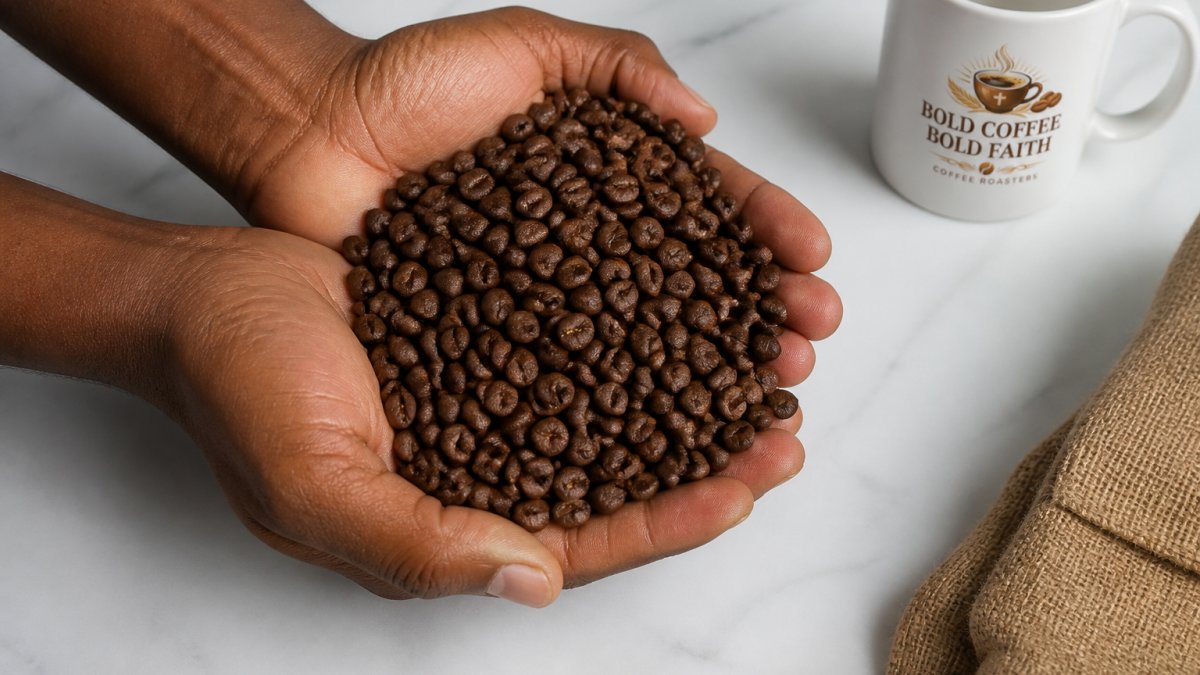
Good whole coffee beans should look glossy with a rich, dark color appropriate to their roast level, and smell vibrant and aromatic, not stale or musty.
Check the roast date.
Look for beans uniform in size and color, inconsistency suggests careless roasting.
Fresh coffee beans have a rich, inviting aroma; if they smell flat or stale, they're past their prime.
Step 2: Grind Your Beans to the Right Size
Grinding is where freshness becomes flavor. The moment you crack a bean, volatile aromatic compounds begin escaping, so grind just before brewing. At HeBrews 11:one, we ship whole beans so the grind happens in your kitchen, not ours.
Why Your Grinder Matters More Than You Think
A grinder turns whole beans into particles of a consistent size, and how well it does that determines how evenly water extracts flavor. Two grinders set to the same "medium" can produce very different cups.
- Blade grinders chop with a spinning blade, producing powder and chunks in the same batch, the powder over-extracts and turns bitter while the chunks under-extract and taste sour. They're fine for coarse methods in a pinch but make dialing in flavor nearly impossible.
- Burr grinders crush beans between two abrasive surfaces and produce far more uniform particles. A hand grinder is a practical, quiet option for pour-over and French press. If you brew often, a burr grinder is the single biggest equipment upgrade you can make.
A useful test: rub a pinch of grounds between your fingers. If you feel both grit and powder, your grind is uneven.
Match Grind Size to Your Brewing Method
Different methods expose grounds to water for different times and pressures, so each needs a different grind. The table below is a starting point, not a rule:
| Brewing Method | Grind Size | Texture | Why It Fits |
|---|---|---|---|
| Espresso | Fine | Like powdered sugar | High pressure and a 25-30 second shot need fast extraction |
| Drip Coffee Maker | Medium | Like sand | Moderate contact time through a paper filter |
| Pour-Over | Medium-Fine | Between sand and powder | Controlled pour extends contact time slightly |
| French Press | Coarse | Like breadcrumbs | A metal mesh lets fines through, so coarse grounds keep sediment down |
| Cold Brew | Coarse | Like breadcrumbs | Long steep (12-18 hours) would over-extract finer grounds |
A finer grind exposes more surface area, so water extracts faster; a coarser grind slows extraction. That principle explains every row in the table.
How Grind Size Shows Up in the Cup
Grind is the fastest variable to adjust when a cup tastes wrong:
- Bitter, harsh, or drying? The grind is likely too fine and over-extracting. Go one step coarser.
- Sour, weak, or thin? The grind is likely too coarse and under-extracting. Go one step finer.
Change one notch at a time and brew again, keeping dose, water, and time constant so you can tell what the grind change did. Small moves beat big ones.
Step 3: Measure Your Coffee and Water Using the Right Coffee-to-Water Ratio for Brewing
Consistency comes from measurement. Use a scale, not a scoop. Scoops vary. Scales don't.
The standard coffee-to-water ratio is one part coffee to sixteen parts water. This is a starting point. Adjust to your taste:
- Stronger coffee: Use a 1:15 ratio (more coffee, less water)
- Weaker coffee: Use a 1:17 ratio (less coffee, more water)
- Very strong: Use a 1:14 ratio
For example, if you're brewing 300 grams of water, use about 18-20 grams of ground coffee. A kitchen scale makes this simple.
Write down what works. Using the same coffee-to-water ratio every time teaches you how your beans and method behave, so you can adjust intentionally instead of guessing.
Step 4: Heat Water to the Best Water Temperature for Brewing Coffee
Water temperature controls extraction speed: too hot over-extracts, too cool under-extracts.
The ideal range is between 195°F and 205°F. Most brewers aim for 200°F. Use a thermometer to check. Let boiling water cool for about 30 seconds, this brings it to the right temperature.
Water quality matters too. Chlorine and minerals affect flavor, so if your tap water is heavily chlorinated or very hard, filtering makes a real difference.
Step 5: Brew and Learn How Long to Brew Coffee
Brew time varies by method. Use a timer every time.
Coffee Sample Pack | 6 Best Selling 2oz Coffee Bags →
Timing by Brewing Method
Drip Coffee Maker: 5-10 minutes total. Water flows through grounds. Most machines handle this automatically.
Pour-Over: 3-4 minutes. You control the pour. Slow and steady extraction.
French Press: 4 minutes. Grounds steep in hot water. Stir after 30 seconds, then wait.
Espresso: 25-30 seconds. High pressure forces water through grounds fast. Timing is tight here.
Watch for these signs:
- Sputtering or hissing, Water is too hot or pressure is too high
- Weak, watery taste, Brew time was too short or grounds were too coarse
- Bitter, harsh taste, Brew time was too long or grounds were too fine
- Sour taste, Water was too cool or brew time was too short
Taste and adjust: if bitter, shorten brew time or grind coarser; if sour, extend brew time or grind finer. Small changes create big differences.
Best Coffee Brewing Methods for Beginners
The method you choose changes three things at once: grind size, coffee-to-water ratio, and brew time. Understanding how those move together separates a recipe you can follow from one you can adjust. Here's how the most common methods compare, followed by steps for each.
Method Comparison at a Glance
| Method | Grind | Starting Ratio (coffee:water) | Brew Time | Control Level |
|---|---|---|---|---|
| Drip Coffee Maker | Medium | 1:16 | 5-10 minutes | Low |
| Pour-Over | Medium-Fine | 1:16 | 3-4 minutes | High |
| French Press | Coarse | 1:15 | 4 minutes | Medium |
| Espresso | Fine | Roughly 1:2 (dose to yield) | 25-30 seconds | High |
Read the table as trade-offs: drip gives convenience for control, pour-over gives control for attention, French press gives body for some sediment, and espresso gives intensity for a steep learning curve.
Drip Coffee Maker
Drip makers are simple and reliable. Water heats, drips through grounds, and collects below. No skill required.
Pour cold water into the reservoir. Add a filter. Add medium-ground coffee at about 1:16. Press start. In minutes, you have a full pot.
The downside: you can't control water temperature or pour rate, which limits dialing in flavor. But drip makers are forgiving and consistent. If your coffee tastes weak, the usual fix is a slightly finer grind or more coffee, not a longer brew.
Pour-Over
Pour-over puts you in control: heat water, pour it slowly over grounds, and watch the brew happen.
Place a filter in the dripper and rinse it with hot water to remove paper taste and preheat the vessel. Add medium-fine grounds at about 1:16. Pour just enough hot water (195°F-205°F) to wet the grounds and let them bloom for about 30 seconds, which releases trapped gases.
Pour-over rewards attention. If the drawdown stalls, your grind is too fine; if it races through, it's too coarse.
French Press
French press steeps grounds directly in hot water, producing rich, full-bodied coffee.
Add coarse grounds to the pot at about 1:15. Pour hot water over them. Stir gently. Cover with the lid (don't press yet). Wait 4 minutes. Press the plunger down slowly.
French press is forgiving on timing but not on grind: too fine, and the mesh lets sludge through, turning the cup muddy and bitter. Some like the extra body; others prefer a paper filter's clarity.
Espresso
Espresso forces hot water through a compacted bed of fine grounds under pressure. It's the least forgiving method, and grind matters most.
Dose your grounds into the portafilter, distribute them evenly, and tamp with firm, level pressure. Lock the portafilter in and pull a shot. A typical starting point is a 1:2 ratio (for example, 18 grams in, about 36 grams out) in 25-30 seconds. If the shot runs fast and tastes sour, grind finer. If it chokes and tastes bitter, grind coarser.
Which Method Should You Start With?
Want least effort? Start with drip. Want to learn how coffee brews? Start with pour-over. Want body and forgiveness? Start with French press. Already own an espresso machine? Accept that dialing in takes a few bags of beans, and treat each shot as practice.
Whichever you choose, the same three levers apply: grind, ratio, and time. Learn them on one method and you can carry that understanding to any other.
Frequently Asked Questions
How fresh should your coffee beans be before brewing?
Ideally, brew fresh coffee beans within 2-4 weeks of the roast date printed on the bag. Beans are at peak flavor 5-10 days after roasting, once they've released excess CO2. Whole beans stay fresher longer than pre-ground coffee. Store them in an airtight container away from light, heat, and moisture. HeBrews 11:one roasts in small batches and ships within one day of your order, ensuring maximum freshness when they arrive at your door.
What coffee-to-water ratio should you use for fresh beans?
A standard coffee-to-water ratio is 1:16 (1 gram of coffee to 16 grams of water). For a simpler measurement, use 1 tablespoon of ground coffee per 6 ounces of water. If you prefer stronger coffee, adjust to 1:15. Weaker coffee works at 1:17. Consistency matters more than perfection, measure the same way each time so you can dial in your preference. Using a scale gives the most accurate results.
Should you use boiling water to brew fresh coffee beans?
No. Boiling water (212°F) over-extracts coffee and creates bitterness. The best water temperature for brewing coffee is 195-205°F. If you don't have a thermometer, boil water and let it cool for 30 seconds before pouring. This temperature extracts the right amount of flavor without burning the grounds. Cooler water under-extracts, leaving your coffee weak and sour.
How long should you brew fresh coffee beans?
Brewing time depends on your method. Drip coffee makers typically brew in 5-10 minutes. Pour-over takes 3-4 minutes. French press steeps for 4 minutes. Espresso extracts in 25-30 seconds. The longer grounds contact hot water, the more flavor and caffeine extract. If your coffee tastes bitter, reduce brew time. If it tastes weak or sour, increase it slightly.