

How to Identify Fair Trade Coffee: A Practical Guide
Last Updated: October 30, 2026
Quick Summary
Fair trade coffee is coffee sold under a recognized third-party certification that sets standards for farmer pricing, working conditions and community support. To identify it, look for a specific certification seal with a named certifier and a license code on the package, not just the plain words "fair trade.
- Confirm a recognized certification logo appears on the package and read the certifier's name beside it.
- Note the license or certificate code, then search the certifier's public database to match the product.
- Check that the certificate covers the exact product or blend name and origin printed on the bag.
- Treat phrases like "ethically sourced" or "fair price" without a named certifier as unverified marketing claims.
- Certification confirms standards were met at audit time, but it does not guarantee perfect conditions on every farm.
Table of Contents
- Why a Christian Coffee Company Cares About Fair Trade Coffee
- What Fair Trade Coffee Means and How Certification Works
- Recognizing Fair Trade Coffee Labels on the Package
-
How to Verify Fair Trade Coffee Claims: A Step-by-Step Checklist
- Step 1: Find the seal and read the certifier's name
- Step 2: Look for a license or certificate code
- Step 3: Check the origin and the product name
- Step 4: Search the certifier's public database
- Step 5: Verify online purchases before checkout
- Step 6: Ask at the café or roaster
- Step 7: Assess non-certified coffee on evidence, not adjectives
- What certification does and does not prove
- Fairtrade vs. Direct Trade Coffee: What Each Promises
- What Certification Does and Does Not Guarantee
- Booking Your Next Cup With Confidence: Choosing HeBrews 11:one Coffee
- Frequently Asked Questions
Why a Christian Coffee Company Cares About Fair Trade Coffee
At HeBrews 11:one, we are a Christian-owned business, and we believe our coffee should reflect our faith. Fair treatment of farmers is part of how we live out that conviction.
Fair trade coffee is coffee sold under a certification that sets standards for farmer pricing, working conditions and community support.
Fair trade is not a guarantee of perfection, and the label alone does not tell the full story.
What Fair Trade Coffee Means and How Certification Works
Fair trade coffee is coffee grown and traded under standards set by certification bodies. These standards cover prices, labor conditions and environmental practices.
Certification usually works in a few steps:
- Farmers or cooperatives apply and agree to meet written standards.
- Independent auditors inspect farms and records.
- Certified buyers pay a minimum price plus a premium that goes back to the producer organization.
A minimum price can act as a safety net when market prices fall (Fairtrade International secures a stronger safety net for coffee farmers).
Certification is not the only path to fair treatment. Some roasters buy directly from farms and publish their own pricing.
Recognizing Fair Trade Coffee Labels on the Package
Start with the front of the bag. A genuine certification seal is a specific graphic mark, not a phrase.
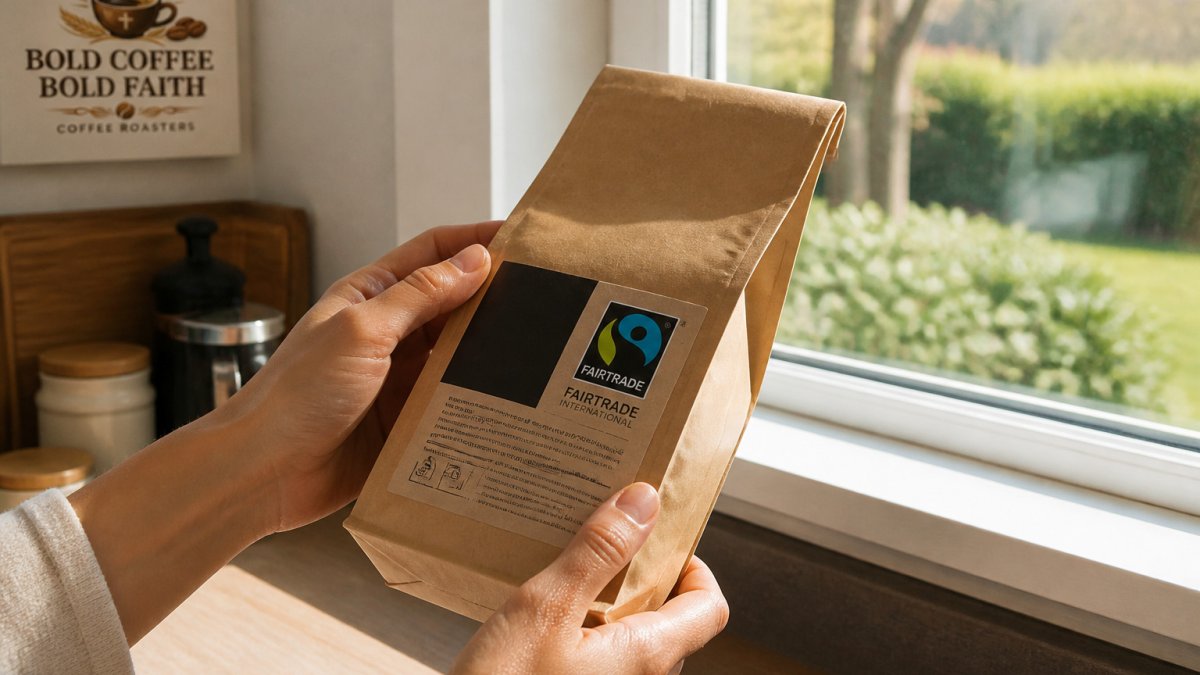
Turn the bag over and check the back panel.
Pay attention to the exact wording. Certification marks are protected, and the way a company is allowed to use them is spelled out in licensing agreements.
!Close-up of a hand holding a coffee bag under a kitchen window, turning it to read the printed certification seal on the front label
Fairtrade International Mark vs. Fair Trade Certified
Two names confuse many shoppers, and the distinction matters when you are checking a label.
Fairtrade International is the international standard-setting and labeling organization. The mark signals that the product met the Fairtrade Standards for coffee, which cover minimum prices, the Fairtrade Premium, labor conditions, and environmental requirements (Fairtrade standards).
Fair Trade Certified is a separate certification mark used in the United States, administered by a U.S.-based certifier.
Both programs aim at similar goals, but they are separate systems with separate standards documents, separate audit processes, and separate licensee lists.
Similar-Sounding Claims That Are Not Certification
Some phrases sound like certification but carry no third-party audit behind them. Watch for:
- "Fair trade" printed in plain text with no seal, no certifier name, and no license number
- "Fairly traded" or "fair price" with no named certifying body
- "Ethically sourced" or "responsibly sourced" with no standard or auditor named
These phrases may reflect real effort by a roaster. The problem is that they cannot be checked the way a seal can, because there is no public standard, no audit trail, and no licensee record to search. For guidance on checking charity and donation claims, see verifying coffee charity donations. Treat them as marketing claims until you see evidence you can verify.
A Quick Comparison of Common Coffee Marks
Labels overlap, and it helps to know what each one is actually certifying.
- Fair trade marks (Fairtrade International, Fair Trade Certified): focus on minimum prices, a premium paid to producer organizations, labor standards, and some environmental requirements. This is the mark to look for when fair pricing is your priority.
- USDA Organic: certifies that the coffee was grown and handled under the USDA National Organic Program rules, which restrict synthetic inputs and require organic system plans and inspections. It says nothing about the price paid to farmers.
- Rainforest Alliance: focuses on environmental and social criteria on farms and in supply chains, including biodiversity, water, and worker conditions. It is not a fair-trade price standard.
A bag can carry more than one mark. When it does, read each one separately, because each certifies a different set of things. The fair trade mark is the one that speaks to price and premium; the others speak to farming methods, habitat, or labor in different ways.
How to Verify Fair Trade Coffee Claims: A Step-by-Step Checklist
Most guides stop at "look for the seal." That is the easy part. The harder part is verifying a claim when you cannot hold the bag, when you are buying a cup at a café, or when the coffee carries no certification at all. Use this checklist in order, and stop at the first step that fails.
Step 1: Find the seal and read the certifier's name
Confirm a recognized certification logo is printed on the package, and read the certifying organization's name next to it. A logo alone is not enough. You want to know which program issued it, because the standards and the licensee records differ between programs.
Step 2: Look for a license or certificate code
Certified products commonly list a license or certificate number on the packaging. Write it down. This is the single most useful piece of evidence on the bag, because it is what lets you match the product to the certifier's own records.
Step 3: Check the origin and the product name
Note the country or region and the exact product or blend name. Certificates cover specific products and facilities, not a company's entire catalog. Matching the product name to the certificate prevents you from assuming a certification covers a bag it does not.
Step 4: Search the certifier's public database
Most certification programs publish searchable listings of licensed companies and products. Search the company name and, where the database allows, the license code. If the company or product does not appear, ask the seller why before you buy.
Step 5: Verify online purchases before checkout
When you buy from a website, you often cannot see the back of the bag. Do three things:
- Look for a product image that shows the certification seal, not just a marketing badge in the page banner.
- Check whether the product page names the certifier and lists a license code in the specifications or the packaging details.
- If the seal and code are not shown, contact the seller and ask which certifier licenses the product and for the license code. A seller who holds a real certification can answer this quickly.
Step 6: Ask at the café or roaster
If you buy by the cup or in bulk, ask the staff which certifier they use and where the license is listed. A café that pours certified coffee should be able to name the program and point you to the licensee record. If the answer is vague, ask whether the coffee is certified at all or whether the claim is a general sourcing statement.
Step 7: Assess non-certified coffee on evidence, not adjectives
Plenty of good coffee is sold without a fair trade seal. When there is no certification, shift from checking a mark to checking for evidence. Look for:
- Named farms or cooperatives rather than a vague country of origin.
- Published prices paid to producers, or a clear statement of how the roaster sets farmgate prices.
- Relationship details such as how long the roaster has bought from the producer and how often they visit.
A roaster who publishes farm names and prices is giving you something checkable. A roaster who publishes only adjectives is not.
What certification does and does not prove
Certification confirms that a product met a defined set of standards at the time it was audited. It supports minimum prices, premiums, and labor rules, and it gives you a paper trail to check.
It does not prove that every worker on every farm was treated perfectly every day, that the coffee tastes better, that the full retail price reaches the farmer, or that one standard fits every region equally well.
Use the seal as one strong signal, then layer on the evidence you gathered in Steps 5 through 7. That combination, a verifiable mark plus transparent sourcing details, is what separates a checked claim from a hopeful one.
The checklist runs in order, so each step builds on the last. The table below summarises the steps.
| Step | What to do | Key check |
|---|---|---|
| 1. Find the seal | Confirm a recognized logo and read the certifier's name | Logo plus named certifier |
| 2. Find the code | Note the license or certificate number on the pack | Matches certifier records |
| 3. Check origin | Record the country, region and product name | Certificate covers this product |
| 4. Search database | Look up the company or license code in the public listing | Appears in the certifier's database |
| 5. Verify online | Check the product page for seal and code before checkout | Seal and code are visible |
| 6. Ask the café | Ask which certifier and where the license is listed | Staff name the program |
| 7. Assess non-certified | Look for named farms, published prices and audits | Evidence, not adjectives |
Fairtrade vs. Direct Trade Coffee: What Each Promises
Fairtrade is a third-party certification with fixed minimum prices, audits and community premiums.
Direct trade can be transparent and generous, but it has no single standard. Two roasters can both say "direct trade" while publishing very different details.
For shoppers, the choice depends on what matters most. Choose certification if you want a checkable standard. Choose direct trade if you want a roaster who publishes farmer-paid prices and origin details.
What Certification Does and Does Not Guarantee
Certification guarantees that a product met a set of standards when it was audited. It supports minimum prices, premiums and labor rules.
It does not guarantee:
- That every worker on every farm is treated perfectly at all times
- That coffee quality or taste is higher
- That the price you pay reaches the farmer in full, since roasting, shipping and retail add cost
Certification is one useful tool among several. Combine it with other signals, such as published pricing and origin details, to form a clearer picture. You can read a deeper look at ethical coffee sourcing benefits to see what those signals can and cannot show.
Booking Your Next Cup With Confidence: Choosing HeBrews 11:one Coffee
We hope this guide makes your next coffee purchase easier to check. As a Christian-owned business, HeBrews 11:one is committed to spreading the Gospel of Jesus Christ by donating 20% of our profits to support various ministries.
If you want a single origin to try, our Uganda Coffee Beans come from Sipi Falls. Our Peru coffee is a medium roast with notes of salted caramel and citrus, and Guatemala coffee beans offer a rich volcanic-grown cup.


Before you buy, check the label using the steps above. If you are looking for faith-aligned gift ideas, compare these best coffee for Christian gifts picks.
Frequently Asked Questions
How can you tell if coffee is fair trade?
Look for a recognized certification mark on the package, such as the Fairtrade International mark or the Fair Trade Certified seal used in the United States. A certified seal means an independent certifier audited the supply chain against published social, economic, and environmental standards. Vague phrases like 'ethically sourced' or 'farmer friendly' printed without a seal are marketing language, not proof. You can also check whether the roaster names the farm, cooperative, or origin and publishes the prices it pays producers.
What labels indicate that coffee is Fair Trade Certified?
In the United States, the Fair Trade Certified seal from Fair Trade USA is the label to look for on coffee bags. The Fairtrade International mark, a blue and green design, appears on products sold in many other countries and signals the same type of third-party certification. Each mark points to a certifier that inspects farms and producer organizations. Confirm the seal is printed on the bag itself and not only in a product description.
Is Fair Trade coffee the same as direct trade coffee?
No. Fair trade certification is a third-party program with published standards, audits, and a minimum price safety net. Direct trade is a sourcing relationship in which a roaster buys straight from farms or cooperatives, usually without a standardized certifier. Direct trade can be transparent and fair, but it is not verified by an outside body in the same way. Both approaches can be valid, so the right choice depends on whether you want an independent audit or the roaster's own documented relationships.
How can I verify a coffee brand's fair trade claim?
Start by checking for a certification seal and its license number or certifier name. Then search the certifier's public database to confirm that the roaster or product is listed. Ask the roaster which cooperative or farm the beans came from and what price was paid. A brand that cannot name its origin or explain its sourcing has a weaker claim than one that can. Certification is verifiable, so a roaster that is genuinely certified will usually point you to the proof.
